

Founded in 2012, Bubble helped pioneer no-code app building — no question. But the landscape has evolved, and so have the expectations. If you’ve outgrown Bubble’s limitations in performance, flexibility, or scalability, Nodavelo is the modern alternative built for serious web apps.
Let’s look at how they stack up.
Nodavelo vs Bubble: Main Difference
Nodavelo and Bubble are both app builders, but they use different architectures.
Bubble is an all-in-one platform where the frontend, backend, database, workflows, and hosting live inside Bubble.
Nodavelo is a visual development platform that lets teams build the frontend visually, use Nodavelo’s native backend, or connect to external backends and APIs such as Xano, Supabase, Airtable, REST, GraphQL, and SOAP APIs.
The main difference is architectural control. Bubble is often a strong choice for MVPs and teams that want one platform to manage everything.
Nodavelo is a better fit for builders that want more control over frontend design, backend flexibility, code export, hosting, scalability, and long-term ownership.
TL;DR: Nodavelo vs Bubble
All-in-One vs Modular
Bubble is an all-in-one tool: frontend, backend, and logic live in the same space. It’s convenient, especially for solo builders or those new to no-code. You only need to learn one system and pay for one platform.
Nodavelo is a full-stack platform . You can build both your frontend and backend in Nodavelo, or connect to external backends like Airtable, Xano, Supabase, or your own APIs. This modular approach mirrors how professional development teams work and lets you optimize each layer of your app independently.
Why Nodavelo Is Modular by Design
Nodavelo is a full-stack, modular platform with a native backend. You can build your frontend and backend in Nodavelo, connect external services like Airtable, Xano, Supabase, or your own APIs, or mix and match them.
This flexibility lets you optimize performance at every layer. For example, if your app slows down as you scale, you can upgrade or replace your backend without rebuilding your UI.
Its modular architecture makes Nodavelo a natural fit for teams that already have a backend or want to connect to multiple data sources without compromising on speed, security, design, or scalability.
Nodavelo integrates natively with tools like Supabase, Airtable, and Xano, and supports any REST, GraphQL, or SOAP API. You can connect your data using standard API documentation, without relying on proprietary logic.
This makes integrations faster and more intuitive for developers and teams already familiar with modern web practices.
Responsive Design Experience
Designing responsive layouts in Bubble has improved over time, but the experience still feels cumbersome compared to modern standards.
In contrast, Nodavelo provides a lightweight abstraction layer built directly on top of the latest web technologies, enabling more precise control.
As a result, building pixel-perfect designs in Nodavelo is faster, more intuitive, and closely resembles the workflow familiar to users of Figma or Webflow. This makes Nodavelo a natural choice for professionals who value both design flexibility and efficiency.
Figma import & Design Best Practices
Because Nodavelo operates as a thin layer over real HTML and CSS, the platform is especially intuitive for designers. If you’re comfortable working in Figma, Webflow, or similar design tools, the transition to Nodavelo is seamless.
A standout advantage is Nodavelo’s reliable Figma import feature, which lets you bring your designs directly from Figma into Nodavelo—preserving structure, styles, and responsive layout details:
The import wizard helps ensure your design tokens, images, and fonts are carried over accurately, reducing manual adjustments and saving valuable time for professionals used to prototyping in Figma.
Nodavelo also supports web development best practices, enabling you to create and share reusable component libraries with built-in versioning. This ensures design systems remain consistent and scalable for creative and enterprise teams alike.
Visual Logic & Workflows
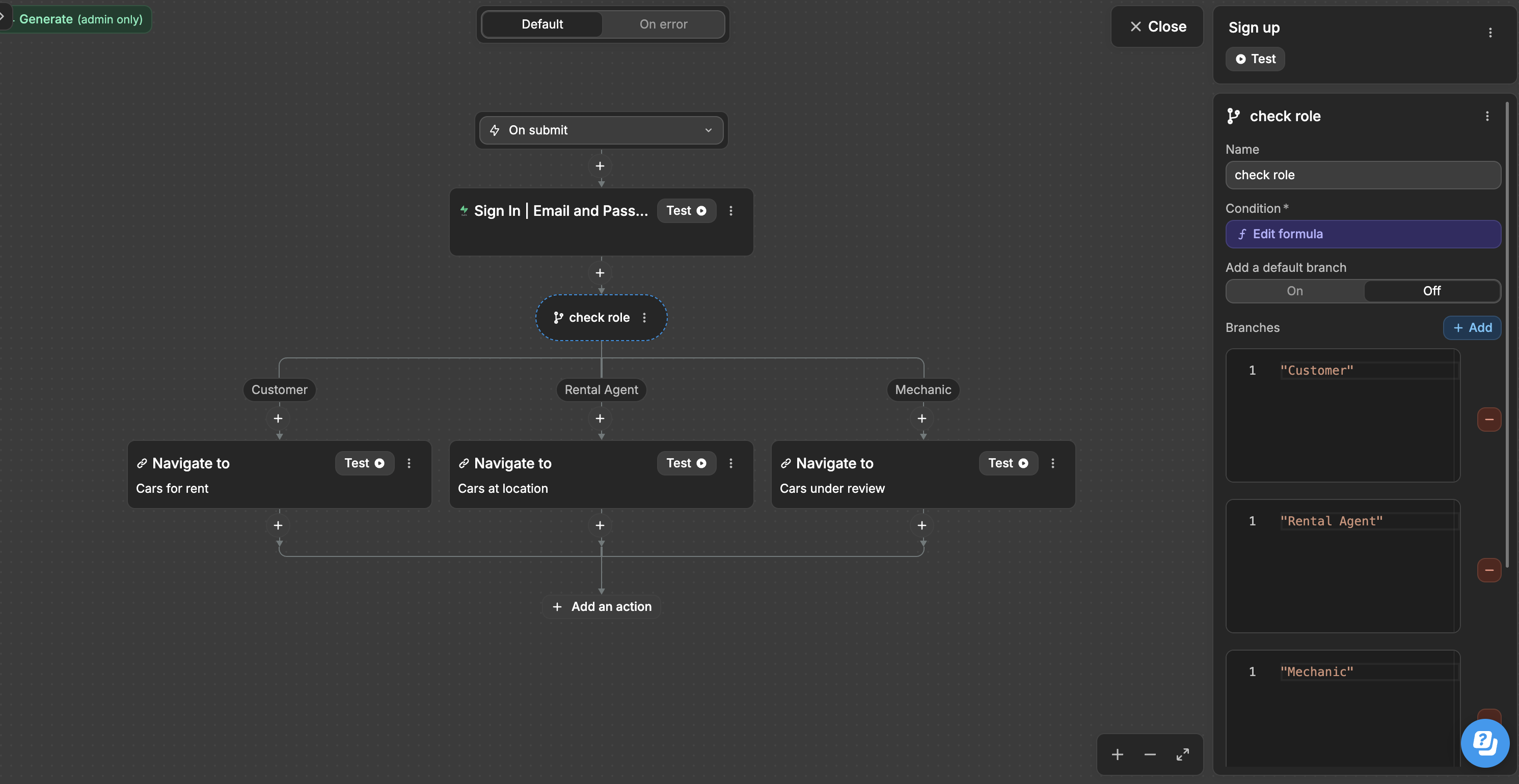
Nodavelo’s visual workflow editor lets you create conditional logic, loops, error handling, and multi-branch flows with ease. Just drag and drop blocks, and build logic visually.
In Bubble, workflows are powerful, but follow a linear path and are hard to adapt to complex conditional needs.
Nodavelo gives you more control and flexibility. If you’ve used tools like n8n, Zapier, or Make, the experience will feel familiar and empowering:
Custom Components & Libraries
Need to integrate an external library or build a custom component? In Bubble, adding advanced functionality means developing a plugin through Bubble’s proprietary system, which can limit flexibility and portability. Nodavelo takes a more developer-friendly approach: you can easily connect to any third-party API using standard protocols like REST or GraphQL.
For deeper customization, Nodavelo lets you create and import your own coded components directly in Vue.js, with full access and control inside the editor. Import components seamlessly from your GitHub projects, ensuring continuity with your existing workflows and assets.
What truly sets Nodavelo apart is its AI-powered component builder: simply describe the component you need in natural language, and Nodavelo’s AI will generate fully editable Vue.js code for you. You can specify preferred libraries or styles to match your requirements, making advanced development accessible and efficient.
Since Nodavelo adheres to open web standards, your work is never locked into a proprietary format—everything you build is compatible with industry-standard tools and enjoyed by experienced developers.
Export Options & Hosting
Bubble apps only run on Bubble’s servers. You can’t export the code or host it yourself. (Source: Bubble user docs on how Bubble hosting works, accessed on October 22nd, 2025)
Nodavelo takes a completely different approach. You can export your full app as a Vue.js single-page application (SPA). That means you can host it anywhere: on Vercel, Netlify, AWS, or even your own infrastructure.
You get full ownership and flexibility, without being tied to Nodavelo’s servers.
You can even push the code of your Nodavelo app directly to GitHub:
Privacy & Compliance Considerations
Because you can self-host your Nodavelo app and control your backend data entirely, it’s possible to build apps that comply with data privacy regulations like GDPR or HIPAA.
Even while you’re building in Nodavelo, your dynamic data never touches our servers, giving you full control from day one.
AI Features & Innovation
Both Bubble and Nodavelo have integrated AI into their platforms, a trend that’s reshaping how we approach no-code development.
In June 2024, Bubble introduced its first AI features: an AI-powered page designer, personalized app build guides, and integrations with AI models like OpenAI's GPT and Anthropic's Claude 3.7 Sonnet.
Nodavelo, on the other hand, began exploring AI-assisted development early. In 2022, it released an OpenAI integration and launched its first AI helper: an assistant that could write no-code formulas and generate animations. By early 2025, AI became a deeply integrated part of the Nodavelo building experience.
Today, users can ask Nodavelo AI and MCP to:
- Generate responsive UIs from text prompts or screenshots
- Build and configure backend logic using editable edge functions directly inside the Nodavelo Editor
And more.
These features are deeply integrated into Nodavelo's visual editor, helping both technical and non-technical users move faster without sacrificing control or customization.
While both platforms offer ways to integrate AI into your workflows, Nodavelo’s native AI assistant — combined with its early investment in this space — gives it an edge for builders looking to accelerate development without giving up flexibility or customization.
FAQ: Nodavelo vs Bubble
Is Bubble or Nodavelo better for beginners?
Nodavelo combines a powerful AI builder with an intuitive no-code interface and a smoother learning curve for users familiar with design tools like Webflow or Figma, making it easier for visually oriented beginners to get started. While Bubble is also beginner-friendly, its distinctive logic and more complex workflows demand a steeper learning investment, so complete no-code newcomers often find Nodavelo faster to grasp.
Bubble vs Nodavelo for building SaaS products
While Bubble is often promoted as a complete solution for building SaaS products, its pricing model—based on “workflow units” (WU)—can pose serious issues once your app starts to scale (or if you inadvertently misconfigure something; an experienced Bubbler even reported hitting expensive usage limits with as few as five people using his app!). As user activity increases, workflow unit consumption grows quickly, resulting in unpredictable and potentially steep costs for successful apps. Many developers have reported surprise billing spikes after growth or have needed to drastically redesign their apps to minimize WU usage.
This unpredictability means SaaS founders must not only optimize efficiency from day one, but also monitor usage closely, since background tasks, automations, and user interactions can quickly exceed plan limits. For most scaling SaaS businesses, Nodavelo combined with a dedicated backend (Nodavelo native, Xano, Supabase, or custom) is favored for cost transparency, performance, and the freedom to optimize infrastructure as the app grows.
In summary, Bubble may be suitable for launching MVPs and prototypes, but its consumption-based pricing and backend constraints make it risky for high-growth SaaS unless you can tightly control every workflow and user action. Nodavelo with scalable backend options provides stronger long-term scalability, predictability, and flexibility for serious SaaS teams.
Nodavelo with Xano vs Bubble all-in-one
Bubble’s all-in-one approach is easier for fast MVPs and for users who prefer a single platform for both front end and back end, but can be less flexible or scalable for complex needs.
Nodavelo paired with Xano (or other backends) gives more control over your app’s logic, scalability, and infrastructure, letting you avoid vendor lock-in and customize each part independently.
Source: Detailed performance review of Nodavelo + Xano vs Bubble
Bubble vs Nodavelo pricing plans
Bubble uses usage-based pricing starting at $29/month tied to app workload units—costs can increase as you scale and remain dependent on Bubble’s hosting. Nodavelo offers simple, transparent pricing starting at $20/month, with the ability to export code and host anywhere. Both offer free starter plans, but Nodavelo’s pricing is generally easier to forecast and manage for growing projects.
What is the difference between Bubble and Nodavelo?
Bubble is an all-in-one no-code platform handling both front end and back end, best for building monolithic web apps where everything lives in one environment. Nodavelo is a full-stack platform focused on flexibility, advanced design customization, code export, and a modular architecture that lets you build with its native backend or connect to any backend via API. It suits teams that need scalability and control over their infrastructure.
Final Thoughts: When to Choose Nodavelo Over Bubble
Bubble is powerful, especially for MVPs or early-stage prototypes where speed and simplicity are paramount. But it comes with trade-offs in flexibility, scalability, and long-term control.
Nodavelo is for builders who want to grow beyond MVPs, those who care about clean design, open web standards, and owning their infrastructure. If you’re hitting the limits of Bubble, it might be time to take your app to the next level.
FAQs
What is the main difference between Nodavelo and Bubble?
The main difference between Nodavelo and Bubble is architecture. Bubble is an all-in-one no-code platform with frontend, backend, database, workflows, and hosting in one environment. Nodavelo is a modular visual development platform that lets you build frontend and backend in Nodavelo or connect to external backends, APIs, and databases.
Is Nodavelo a Bubble alternative?
Yes. Nodavelo is a Bubble alternative for those that want more frontend control, backend flexibility, code export, flexible hosting, and scalable architecture. Bubble is better suited to users who want an all-in-one no-code platform, while Nodavelo is better suited to thosse that want a modular app architecture.
Which is better for SaaS apps, Nodavelo or Bubble?
Bubble can work well for SaaS MVPs and early prototypes. Nodavelo is often a better fit for SaaS apps that need custom frontend design, external backend services, scalable infrastructure, code export, and more control over hosting and long-term maintainability.
Can you export code from Bubble or Nodavelo?
Nodavelo supports code export, allowing teams to export their app as a Vue.js single-page application and host it on infrastructure such as Vercel, Netlify, AWS, or their own servers. Bubble does not offer code export, and Bubble apps run on Bubble’s infrastructure.
Ready to explore? Try Nodavelo for free and see how it compares for your next project.